About Rockwell Hardness Testing Machine
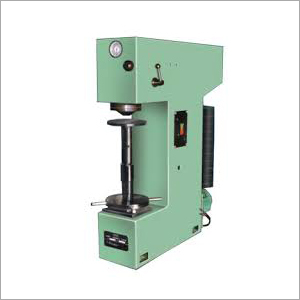
Gratifying the needs of existing market, we are proficient of manufacturing and supplying a qualitative range of Rockwell Hardness Testing Machine. These are present as testing machines that are used for performing numerous industrial applications of different materials. Ranging from large to small scale functioning, these machines are widely demanded among our clients for their unrivaled characteristics. Therefore, our Rockwell Hardness Testing Machines are used in chemical processing, food production and electronic industry for performing various test applications. We are presenting these Rockwell Hardness Testing Machine in numerous models at nominal rates.
Exceptional Accuracy and Durable DesignThis Rockwell Hardness Testing Machine is engineered for precise and repeatable results, conforming to IS standards for optimal quality control. With its powder-coated mild steel structure and hardened internal components, it promises resilience and durability for rigorous daily use in demanding environments.
Versatile Application Across IndustriesCompatible with Rockwell A, B, and C test scales, and offering multiple indenter types and loads, this machine adapts to a wide variety of metal hardness testing scenarios. Its sizable specimen capacity and straightforward manual controls make it an ideal choice for manufacturers, quality labs, and workshops alike.
Effortless Operation and MaintenanceThe analog dial ensures immediate, direct readings, reducing interpretation errors. Its semi-automatic system with manual lever operation, low power consumption, and accessible routine maintenancerequiring only periodic lubrication and checkupsensure reliable, user-friendly performance for all operators.
FAQs of Rockwell Hardness Testing Machine:
Q: How does the Rockwell Hardness Testing Machine measure hardness?
A: The machine applies a controlled initial minor load of 10 kgf followed by a major test load (60, 100, or 150 kgf) using either a diamond or ball indenter. It measures the indentation depth on the specimen, providing a direct hardness reading on the analog dial using Rockwell A, B, or C scales.
Q: What types of samples can be tested and what is the maximum specimen size?
A: This tester can handle a wide range of metals and alloys suitable for Rockwell methods. It accommodates specimens up to 230 mm in height and 200 mm in diameter, making it versatile for both small and moderately large components.
Q: When should the machine be lubricated or serviced?
A: Periodic lubrication is recommended as part of simple routine maintenance. Regular checkups ensure consistent performance and longevity, and spindle oil is included among the accessories for this purpose.
Q: Where can this hardness testing machine be used?
A: Designed for industrial, laboratory, and workshop environments, its robust construction, compact bench-type design, and direct dial reading make it suitable for material testing across many sectors, including manufacturing and quality control.
Q: What are the benefits of using this Rockwell Hardness Testing Machine?
A: Users benefit from high accuracy (1%), direct analog readings, sturdy powder-coated body, standard accessories, and minimal power consumption. Its manual lever and dial system offer reliable operation without complicated electronics, ensuring ease of use and maintenance.
Q: How is the hardness value displayed to the user?
A: The result is displayed directly on an analog dial, enabling instant, unambiguous readings. This reduces chances of digital misinterpretation and streamlines the testing process.
Q: What process should be followed for consistent testing results?
A: Ensure the surface is clean and flat, select the appropriate indenter and test scale, apply the initial and main loads per the control lever, and read the value from the analog dial. Regular calibration and maintenance uphold consistent results.

 Send Inquiry



 Send Inquiry

 Send Inquiry